Overview
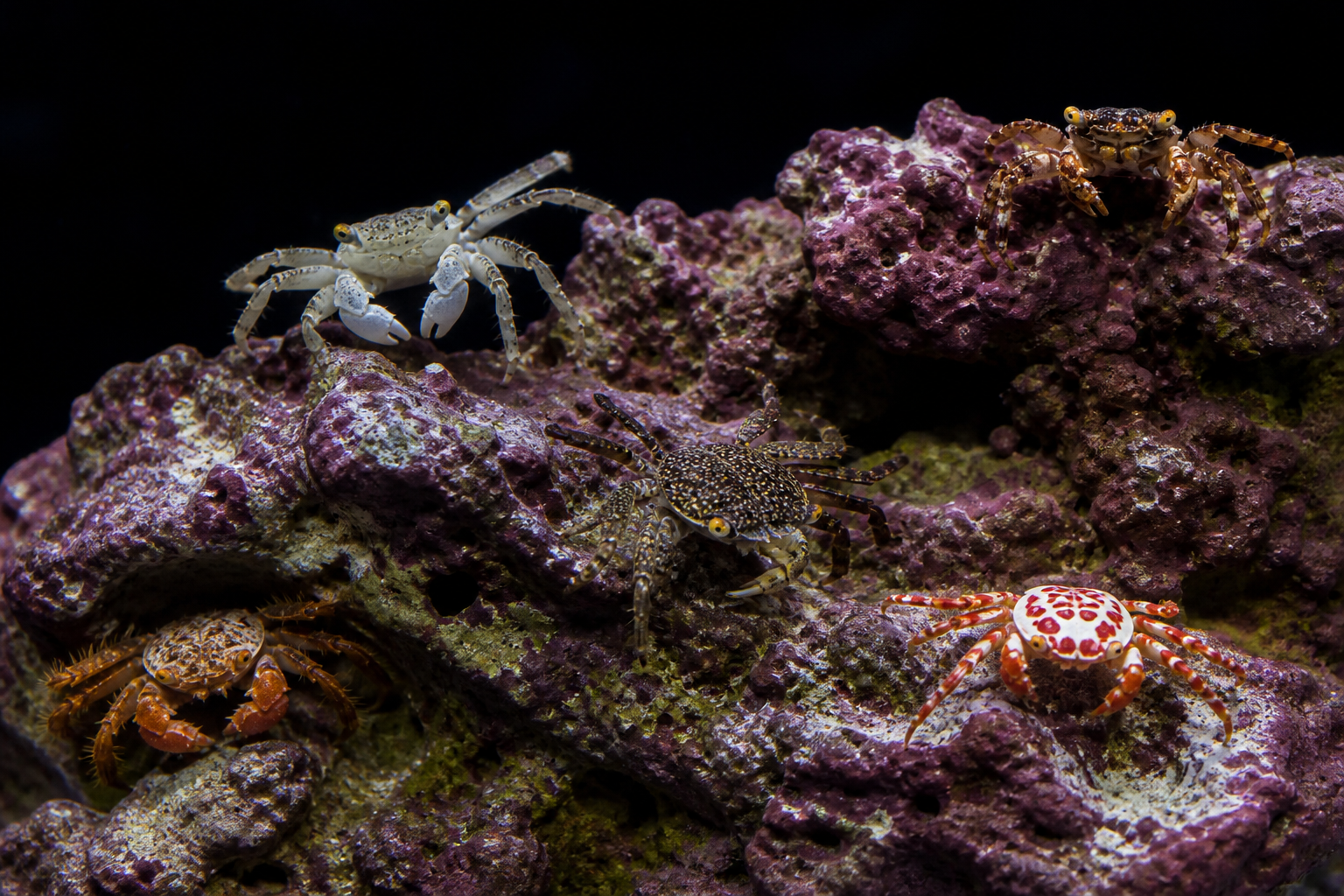
Gorilla crabs (often lumped under xanthid crabs, family Xanthidae) are one of the most common “surprise” hitchhikers in reef tanks. They usually come in on live rock or tucked into coral frags, and you don’t notice them until you start hearing the classic reefkeeper story: “Something is killing my snails… and I never see it.”
Some xanthids are harmless scavengers. Others are absolutely not reef-friendly — they’ll eat snails, pick at corals, steal food aggressively, and generally cause chaos once they get big enough to matter. The problem is that in a home reef tank, you can’t easily tell which type you got until it starts behaving like a criminal.
So as a practical hobbyist rule: unknown xanthid hitchhiker crabs are treated as pests until proven otherwise.
Quick Care Snapshot
Common Name: Gorilla Crab / Xanthid Crab
Scientific Name: Xanthidae (family; many similar hitchhikers)
Reef Safe: Usually no (too risky; many are predatory/omnivorous)
Difficulty: Easy to keep, annoying to catch
Temperament: Opportunistic, often aggressive at feeding time
Activity: Mostly nocturnal
Diet: Omnivore—meaty foods, snails, detritus, coral polyps (varies by species)
Main Risk: Snail losses, coral picking, hidden predation
Best “Care” Goal: Identify early and remove if suspected predatory
Natural Background
Xanthid crabs are a huge family with many species living in reef environments. In the wild, they fill different niches: scavengers, omnivores, and predators. In a reef tank, that variety is exactly the issue: a crab that’s “fine” in the ocean can become a problem when it has:
• Limited food options
• Easy access to snails and coral
• No predators
• A small confined territory
They’re also excellent at hiding in rockwork, which is why they get away with stuff for a long time before you catch them in the act.
Tank Requirements
If your tank has rockwork, a xanthid can live in it. They don’t need special conditions. They’re resilient, adaptable, and good at surviving on leftovers.
They tend to become noticeable when:
• They grow large enough to compete at feeding time
• You start losing snails or small inverts
• You see coral irritation that doesn’t match flow/light issues
• You catch one out at night
Where they hide
• Deep rock crevices
• Under ledges and caves
• Inside porous live rock holes
• Behind the rock structure near the sand line
Feeding
Xanthids are opportunistic omnivores. In reef tanks they’ll eat:
• Leftover fish food
• Meaty foods (mysis, pellets, chopped seafood)
• Detritus
• Small inverts (snails, hermits)
• Sometimes coral tissue or polyps (depending on the crab)
Even if you feed the tank heavily, predatory individuals may still hunt. Feeding doesn’t guarantee “good behavior.” It just keeps them alive while they do what they do.
Compatibility
With corals
Some will ignore coral. Some will pick at coral polyps or flesh—especially at night. The risk is hard to predict without watching behavior.
With clean-up crew
This is where most problems show up:
• Missing snails
• Empty shells
• Hermits “disappearing”
• Cleanup crew that never seems to last
With fish
Usually ignored, but larger crabs can become bold and steal food, stress timid fish, or pinch slow-moving species.
The practical compatibility conclusion
Unknown xanthid hitchhikers are not a good “roll the dice” animal in a reef tank. Even one predatory crab can cause months of mystery losses.
Common Mistakes
1) Assuming “it’s just a crab, it’s part of the reef”
In a reef tank, “part of the reef” can quickly become “predator with no consequences.”
2) Waiting for proof while losses stack up
By the time you’re sure, you’ve often lost a cleanup crew and maybe a coral colony has been irritated for weeks.
3) Only observing during the day
These crabs are often nocturnal. If you’re only looking with daytime lights, you’re missing the crime scene.
4) Letting them establish deep in rockwork
Once a crab claims a deep home in the rock, it’s much harder to remove.
5) Misidentifying harmless crabs as “safe”
Some hitchhiker crabs truly are fine. The issue is you usually can’t verify that confidently in a mixed reef environment—so “safe” becomes a gamble.
Notes & Variations
“How do I know it’s a gorilla crab?”
In hobby language, “gorilla crab” is often used for xanthid-type crabs that look:
• Stocky and rugged
• Hairy legs/arms (often, not always)
• Big, strong claws relative to body size
But the truth is: the label is imprecise. Many crabs get called “gorilla” because they look tough.
Behavior tells you more than the name
If you see any of these, treat it as pest behavior:
• Actively hunting/snatching snails
• Picking at corals
• Aggressively stealing food from corals/fish
• Appearing only at night and retreating instantly
“One crab isn’t a big deal”
Sometimes it is. A single predatory crab can wipe a cleanup crew in a small or mid-size reef.
Final Thoughts
Xanthid crabs are one of the classic “reef tank mysteries.” They’re not always the villain, but they’re common enough and risky enough that they deserve a strict mindset:
If you didn’t intentionally buy it, and you don’t know exactly what it is, don’t let it run your reef.
You’re not being paranoid — you’re protecting your livestock from a hidden omnivore/predator that can live for a long time and cause ongoing losses.